
|
| |

Of course the launch of Sputnik I in 1957 was a milestone in American history,
and it was a turning point in Homer Hickam's life. Since 2007 is the 50th
anniversary of Sputnik I, we thought we would assemble a few facts.
|
Sputnik I Timeline as
It Relates to Coalwood
Launch Time: Friday, October 4, 1957, 19:12 UTC (Greenwich Mean Time)
(1)

Launch Time: Friday, October 4, 1957, 22:12 MSK (Moscow Standard Time at
the launch site)
Launch Time: Friday, October 4, 1957, 15:12 EDT (3:12 p.m.) (Eastern
Daylight Time in Coalwood)
Launch Site: Baikonur Complex, U.S.S.R. (1)
Signal from Sputnik first heard on U.S. radio: The evening of Friday,
October 4, 1957. (2)
First time Homer heard Sputnik's signal on the radio: Saturday, October 5,
1957, early morning.
Sputnik first discussed at Big Creek High School: Monday, October 7, 1957.
(4)
The people of Coalwood saw Sputnik in the sky over Coalwood for the first
time: Sometime between October 7 and November 3, 1957. (5) (11)
Sputnik I burns up as it reenters Earth's atmosphere: January 4, 1958. (6)

We enjoyed the Google header from October 4, 2007.
They titled it "Sputnik - 50th Anniversary".
Interesting
Connections between Sputnik and Mining
Sergey Pavlovich Korolyov (often spelled Korolev) was the head Soviet
rocket engineer and designer during the Space Race between the United
States and the Soviet Union in the 1950s and 1960s. For a time,
Korolev was imprisoned in a Soviet gulag where he worked (basically
as a slave) as a gold miner. (7) (8)
In early 1945, Werner Von Braun and his German rocket team hid the most
important documents related to their rockets in a mine shaft.
After Von Braun's team surrendered to the Americans, the documents were
recovered and transported to the United States where they played a vital
role in America's space program. (9)
Sputnik Article from
NASA (10)
Sputnik 1
NSSDC ID: 1957-001B
Launch Date/Time: 1957-10-04 at 19:12:00 UTC
On-orbit Dry Mass: 83.6 kg
The Sputnik 1 spacecraft was the first artificial satellite successfully
placed in orbit around the Earth and was launched from Baikonur Cosmodrome
at Tyuratam (370 km southwest of the small town of Baikonur) in
Kazakhstan, then part of the former Soviet Union. The Russian word
"Sputnik" means "companion" ("satellite" in the astronomical sense).
In 1885 Konstantin Tsiolkovsky first described in his book, Dreams of
Earth and Sky, how such a satellite could be launched into a low
altitude orbit. It was the first in a series of four satellites as part of
the Sputnik program of the former Soviet Union and was planned as a
contribution to the International Geophysical Year (1957-1958). Three of
these satellites (Sputnik 1, 2, and 3) reached Earth orbit.
The Sputnik 1 satellite was a 58.0 cm-diameter aluminum sphere that
carried four whip-like antennas that were 2.4-2.9 m long. The antennas
looked like long "whiskers" pointing to one side. The spacecraft obtained
data pertaining to the density of the upper layers of the atmosphere and
the propagation of radio signals in the ionosphere. The instruments and
electric power sources were housed in a sealed capsule and included
transmitters operated at 20.005 and 40.002 MHz (about 15 and 7.5 m in
wavelength), the emissions taking place in alternating groups of 0.3 s in
duration. The downlink telemetry included data on temperatures inside and
on the surface of the sphere.
Since the sphere was filled with nitrogen under pressure, Sputnik 1
provided the first opportunity for meteoroid detection (no such events
were reported), since losses in internal pressure due to meteoroid
penetration of the outer surface would have been evident in the
temperature data. The satellite transmitters operated for three weeks,
until the on-board chemical batteries failed, and were monitored with
intense interest around the world. The orbit of the then inactive
satellite was later observed optically to decay 92 days after launch
(January 4, 1958) after having completed about 1400 orbits of the Earth
over a cumulative distance traveled of 70 million kilometers. The orbital
apogee declined from 947 km after launch to 600 km by Dec. 9th.
The Sputnik 1 rocket booster also reached Earth orbit and was visible from
the ground at night as a first magnitude object, while the small but
highly polished sphere barely visible at sixth magnitude more difficult to
follow optically. Several replicas of the Sputnik 1 satellite can be seen
at museums in Russia and another is on display in the Smithsonian National
Air and Space Museum in Washington, D.C.
Trivia
The show Leave It To Beaver made its television debut the
evening of October 4, 1957, the same day Sputnik 1 was launched!
References
(1) Paul Dickson, Sputnik: The Shock of the Century, G.K.
Hall & Co., Waterville, Maine, 2001, p. 193, Large Print Edition.
(2) Ibid, p. 7.
(3) Homer Hickam, Rocket Boys, Delta Trade paperbacks, New York,
2000, p. 16.
(4) Ibid, p. 24.
(5) We are not sure of the exact date. The event is described in
Rocket Boys and occurs sometime between the day Sputnik was first
discussed in Big Creek High School (October 7) and the date the Russians
launched Sputnik II (November 3).
(6) Wikipedia.org.
http://en.wikipedia.org/wiki/Sputnik_1
(7) Wikipedia.org.
http://en.wikipedia.org/wiki/Sergey_Korolyov
(8) NASA.
http://history.nasa.gov/sputnik/korolev.html
(9) Dickson, op. cit, p. 104.
(10) NASA:
http://nssdc.gsfc.nasa.gov/database/MasterCatalog?sc=1957-001B
(11) Based on the above article from NASA, it is likely the people of
Coalwood would have seen Sputnik 1's rocket booster in orbit rather than
the satellite itself.
Photo of Sputnik: NASA:
http://nssdc.gsfc.nasa.gov/database/MasterCatalog?sc=1957-001B
By the way, Homer, the Rocket Boys, and Coalwood are
mentioned in
Sputnik: The Shock of the Century on pages 299 and 422! |

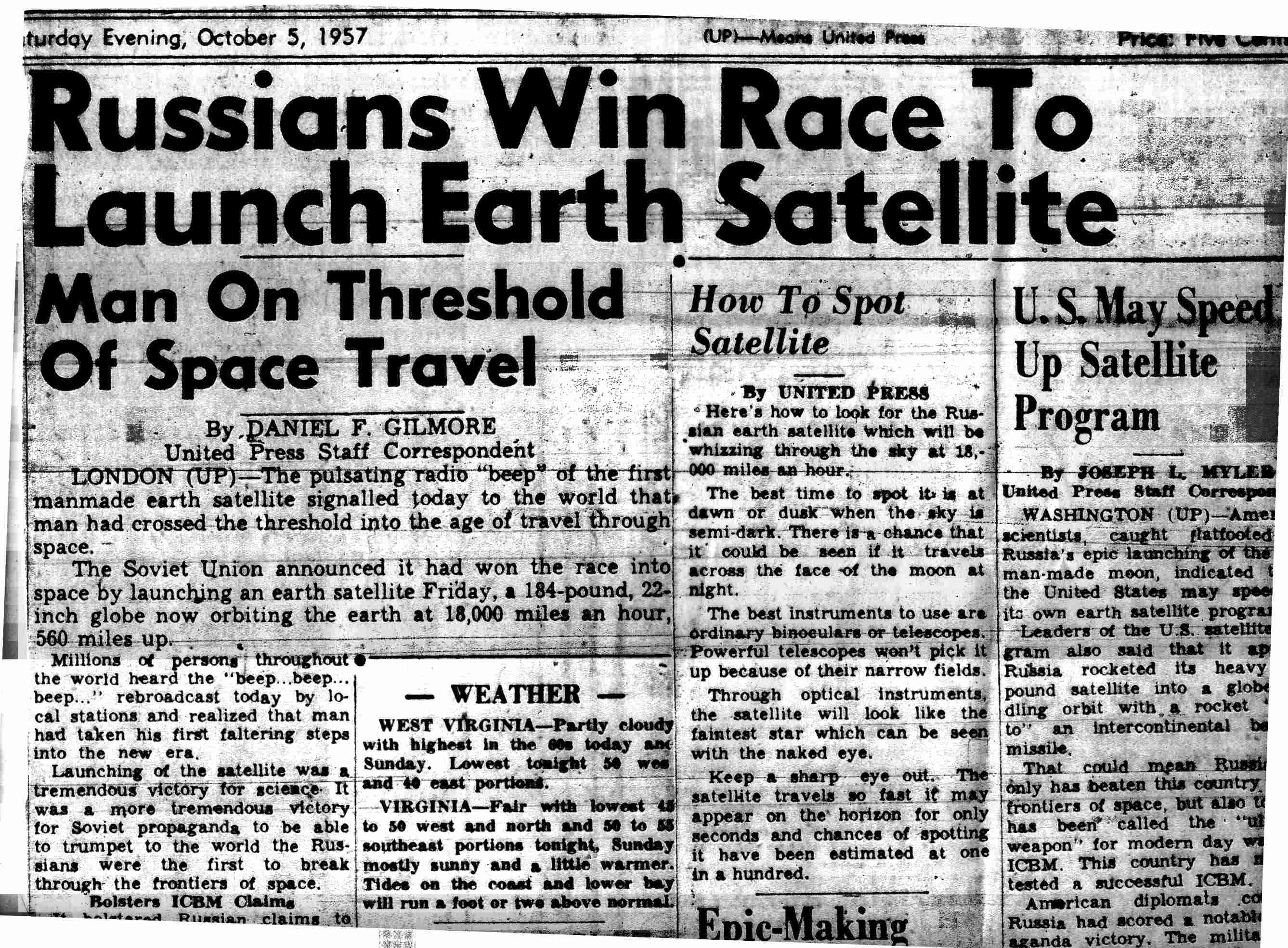
This is part of the front page of the Welch Daily News from Saturday
Evening, October 5, 1957, the day after Sputnik I was launched. We would
like to thank Eleanor Beckner from the McDowell Public Library for searching
through the library's archives and providing us with this image. Actually,
Eleanor provided us with the entire front page of that issue. We have
typed all of the articles below to make them easier to read. Thanks,
Eleanor!
|
Man on Threshold
of Space Travel
By Daniel F. Gilmore
United Press Staff Correspondent
LONDON (UP) – The pulsating radio “beep” of the first manmade earth
satellite signaled today to the world that man had crossed the threshold
into the age of travel through space.
The Soviet Union announced it had won the race into space by launching an
earth satellite Friday, a 184-pound, 22-inch globe now orbiting the earth
at 18,000 miles an hour, 560 miles up.
Millions of persons throughout the world heard the “beep ... beep ... beep
...” rebroadcast today by local stations and realized that man had taken
his first faltering steps into the new era.
Launching of the satellite was a tremendous victory for science. It was a
more tremendous victory for Soviet propaganda to be able to trumpet to the
world the Russians were the first to break through the frontiers of space.
Bolsters ICBM Claims
It bolstered Russian claims to be the first to have perfected an
intercontinental ballistic missile for it might well have taken such a
missile to launch the satellite on its flight around the world every 95
minutes – about 15 times a day.
John P. Hagen, the U.S. satellite chief, told the United Press in an
interview in Washington the rocket that blasted the satellite skywards may
have been “close to” an ICBM.
Hagen, head of Project Vanguard, urged a speedup of the American satellite
program, now set for a launching this fall.
The Russians said more satellites would be launched later. They have said
earlier that satellite marked the first step of travel to the moon and
perhaps to Mars and Venus as well and said travel to the planets might
well begin by 1965.
The speed with which Russia carried out the launching amazed scientists
throughout the world. One had been expected during this worldwide
geophysical year but not for several more months.
The secrecy of the operation annoyed some scientists for they were unable
to warn in time their “moonwatch” teams which observe the satellite.
Another minor annoyance was the fact the Russians changed the agreed upon
radio frequency of the “beeps.”
The Russian announcement, made first by Moscow radio in a broadcast beamed
in English to the United States, said flight of the satellite can “be
observed in the rays of the rising and setting sun with the aid of the
simplest optical instruments, such as binoculars and spyglasses.”
The first man to report seeing the satellite was Larry Ochs of Columbus,
Ohio, one of seven moonwatchers alerted.
In the Massachusetts Institute of Technology, a monstrous electronic brain
began putting together the scraps of information which would result in
exact knowledge of the satellite’s movements.
The size and weight amazed American scientists. The American satellite is
to be 20 inches in diameter and will weight 21 ˝ pounds. Scientists said
the 184-pound weight of the Soviet satellite was astounding. And indicated
that a rocket nearly as powerful as one for an ICBM must have been used.
The first satellite is expected to remain aloft only for a week or two
then when it descends into the atmosphere of the earth its great velocity
over a protracted period will cause it to burn like a meteor.
The White House and Defense and State departments did not comment
immediately but the unofficial attitude was that the development had no
immediate effect on the balance of power.
|
|
–Weather–
West Virginia – Partly cloudy with highest in the 60s today and Sunday.
Lowest tonight 50 west and 40 east portions.
Virginia – Fair with lowest 45 to 50 west and north and 50 to 55 southeast
portions tonight, Sunday mostly sunny and a little warmer. Tides on the
coast and lower bay will run a foot or two above normal. |
|
Must Catch Up
With Russians,
Says Scientists
DENVER (UPI) – Rocket scientist Harry Stine said Friday night that
United States must catch up with the Russians in rocketry quickly or
“we’re dead.”
Stine, author of a recent book on earth satellites, spent five years on
rocket testing and development at White Sands Proving Grounds in New
Mexico and is now engated in secret design work at the Glen L. Martin
missile plant at Denver.
The missile scientists said that the Soviet satellite is so heavy that an
intercontinental ballistics missile (ICBM) must have launched it. And a
workable ICBM means the United States can expect no more than a 15-minute
warning of attack, he said.
Stine said the United States is behind the Soviet Union in rocketry, and
has consistently underestimated Russian scientific capacity.
“We have known in the rocket business for a long time that the Russians
were pretty sharp,” adds Stine. “They took the German V2 after World War
II and went into immediate production. We captured the V2s and fired them,
but didn’t build them.
“We’ve got to catch up fast or we’re dead.” |
|
How To Spot Satellite
By UNITED PRESS
Here’s how to look for the Russian earth satellite which will be
whizzing through the sky at 18,000 miles an hour.
The best time to spot it is at dawn or dusk when the sky is semi-dark.
There is a chance that it could be seen if it travels across the face of
the moon at night.
The best instruments to use are ordinary binoculars or telescopes.
Powerful telescopes won’t pick it up because of their narrow fields.
Through optical instruments, the satellite will look like the faintest
star which can be seen with the naked eye.
Keep a sharp eye out. The satellite travels so fast it may appear on the
horizon for only seconds and chances of spotting it have been estimated at
one in a hundred. |
|
Epic-Making
Event, Say
U.S. Scientists
WASHINGTON (UP) – a voice behind the frosted-glass door said: “They’ve
done it ... and nothing like it can ever happen again!”
The voice was that of an American scientist, talking to other American
scientists.
They were in Room 717 of the Association Bldg. – the offices of the U.S.
Committee for the International Geophysical year.
A few hours before they had heard the news that Russia had launched
mankind’s first artificial moon and taken man’s first real step into outer
space.
The stunning word came at a cocktail party the Russians had hastily called
at their embassy, presumably to make the announcement. But the first word
was given to the American scientists by U.S. newsmen who rushed to the
party after Moscow radio broadcast news of the launching.
The data poured into the offices in the Association Bldg. And was plotted
on global charts stretching flat on a long table.
The reports added up to confirmation: The Russians had done it.
It was only at this moment, in the early hours of the morning, that the
full impact of the Soviet achievement struck the men in Room 717.
They had spent many months preparing to try to accomplish the same thing.
They had wanted to be the first to conquer outer space. Although there was
no race, supposedly, they thought they were ahead.
They tried not to look disheartened as newsmen were ushered into the room.
But their expressions didn’t quite match their words. |
|
U.S. May Speed
Up Satellite
Program
By Joseph L. Myler
United Press Staff Correspondent
WASHINGTON (UP) – American scientists, caught flatfooted by Russia’s
epic launching of the first man-made moon, indicated today the United
States may speed up its own earth satellite program.
Leaders of the U.S. Satellite program also said that it appears Russia
rocketed its heavy 184-pound satellite into a globe girdling orbit with a
rocket “close to” an intercontinental ballistic missile.
That could mean Russia not only has beaten this country to the frontiers
of space, but also to what has been called the “ultimate weapon” for
modern day war – the ICBM. This country has not yet tested a successful
ICBM.
American diplomats conceded Russia had scored a notable propaganda
victory. The military implications of the Soviet feat were tremendous.
No Presidential Comment
President Eisenhower, who first announced plans for the U.S. earth
satellite program July 29, 1955, was informed at his Gettysburg, Pa., farm
of the notable Soviet “feat.” He had no immediate comment.
American scientists involved in the U.S. satellite were at a cocktail
party at the Soviet Embassy here when Moscow radio broke the news. They
rushed back to their headquarters and set in motion a U.S. and worldwide
tracking system to trace the progress of the Soviet moon.
Whey they came out of shock, the scientists said words adding up to fine,
splendid, great. At heart, they were sick. The United States had done 90
per cent of the talking about earth satellites. Russia, it turned out, had
done 100 per cent of the performing.
Having performed, the Russians permitted themselves the luxury of a little
boasting. What they have done, they said in Moscow, “will pave the way for
space travel.” Just last week, they had forecast rocket flights to the
Moon and Mars within a decade.
Reds Kept Silent
Both the U.S. and USSR undertook to send instrument-laden moons into
space as part of the International Geophysical Year (IGY), a cooperative
venture of 64 countries and some 10,000 scientists to strip away mysteries
still veiling the earth.
All IGY nations are pledged to keep each other informed of their projects
and their results. The Russians, however, cloaked their satellite program
in secrecy – until Friday.
Even after their moon was in orbit and flashing radio signals sporadically
picked up in this country and elsewhere, the Russians withheld for the
time being data vital to precision tracking by other nations.
The U.S. moved quickly to remedy this. Some 160 “moonwatch teams” in this
and other nations went to work. |
Eleanor also sent this clipping from the Welch Daily News,
October 14, 1957, page 9.
|
West Virginian
Sights Rocket
or Satellite
Cameron, W. Va. (UP) Two residents of this small Marshall County
community have laid claim to being the first in West Virginia to see the
Russian satellite, Sputnik.
Russell Mathews and a son, Mayes, 14, were trying out a pellet gun near
here Sunday when they noticed a "spec" in the sky.
Mathews said he sighted along the barrel of the gun and followed the
large "spec" for about 30 seconds, or until it was no longer visible.
He also pointed out the object to his son.
The man said he was not sure whether the object may have been the
satellite or its rocket. A short conference at home resulted in
another visit where the shiny object had been seen.
About 96 minutes later, the time it takes for the satellite or its
rocket to circle the earth, the pair saw the "spec" again, Matthews said.
But this time, he said, the spec was "not as clear, though still visible
to the naked eye." |
|